
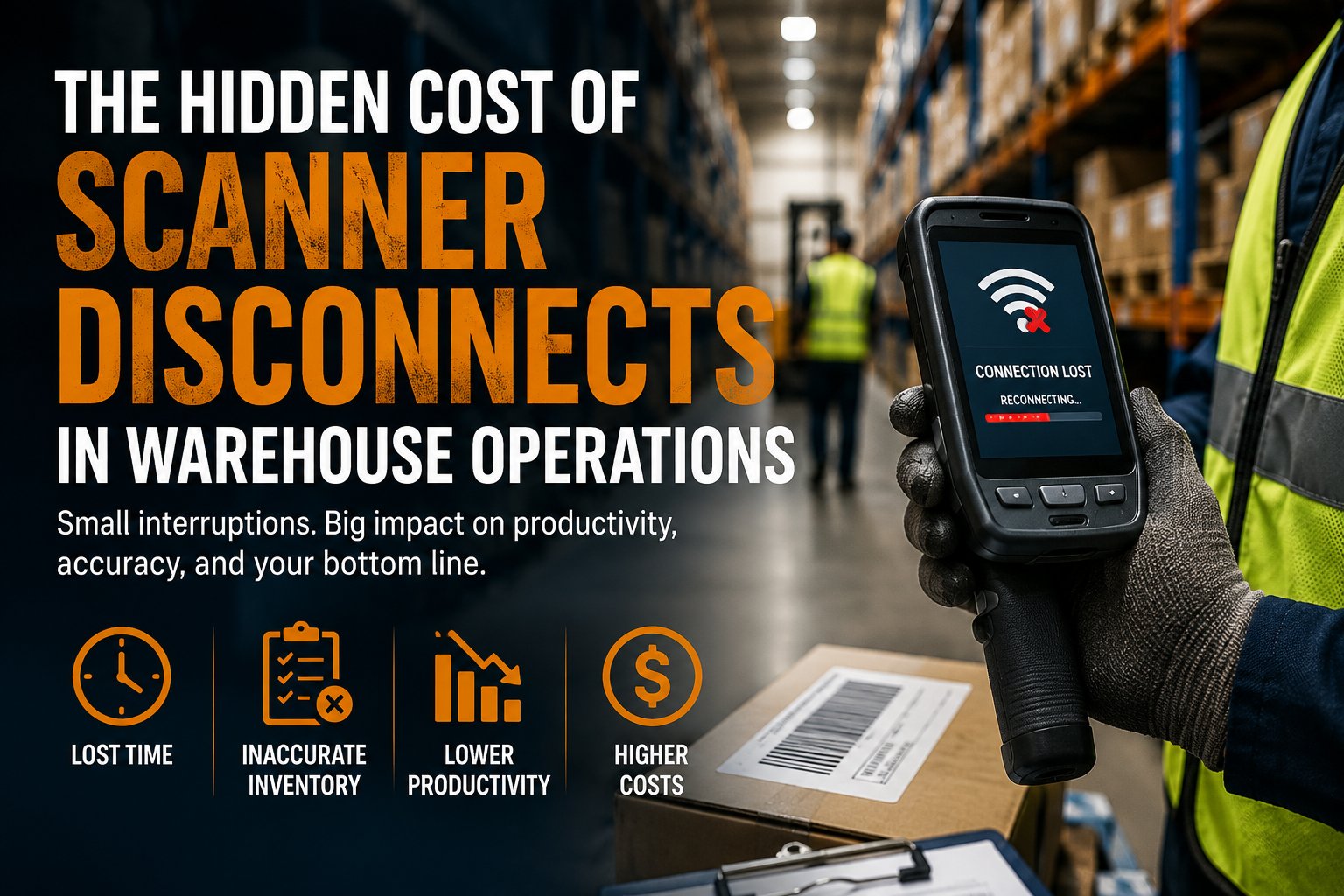
Why a "Small" Technology Problem Creates Big Operational Headaches
Most warehouse managers don't think much about barcode scanners.
At least not when they're working.
When scanners connect instantly, inventory updates correctly, and employees move efficiently through their tasks, they fade into the background. They're simply part of the workflow.
But when scanners start disconnecting, even occasionally, everything changes.
Suddenly employees are stopping what they're doing to reconnect devices. Inventory updates become delayed. Team members start creating workarounds. Supervisors get pulled into troubleshooting conversations. Productivity slows down one interruption at a time.
The frustrating part is that scanner disconnects rarely feel like a major outage.
Instead, they feel like dozens of small annoyances scattered throughout the day.
That's exactly why they become so expensive.
Most Companies Underestimate the Impact
When warehouse leaders think about downtime, they often imagine a major event.
A server crash.
A network outage.
A warehouse management system failure.
Those events are obvious because everything stops.
Scanner disconnects are different.
The warehouse continues operating, but not efficiently.
Employees lose a minute reconnecting.
Then another minute.
Then another.
Multiply that across dozens of employees, multiple shifts, and hundreds of scans throughout the day, and what looked like a minor inconvenience starts becoming a significant productivity drain.
The cost isn't found in a single disconnect.
The cost is found in the cumulative effect of hundreds of interruptions.
The Ripple Effect Across Operations
A disconnected scanner doesn't just affect the employee holding it.
It creates downstream consequences throughout the operation.
When inventory isn't scanned immediately, information becomes less accurate.
When inventory accuracy suffers, receiving, picking, and shipping teams lose confidence in the data they're working from.
As confidence drops, employees begin double-checking information manually.
Manual verification slows processes.
Slower processes reduce throughput.
Reduced throughput affects customer service, shipping timelines, and operational efficiency.
What started as a scanner issue eventually becomes an operations issue.
That distinction is important because most organizations spend too much time troubleshooting devices and not enough time understanding the business impact.
Why Scanner Disconnects Keep Happening
Many warehouse leaders assume the scanner itself is the problem.
Sometimes it is.
More often, the disconnects are symptoms of a larger issue.
Common causes include:
Warehouse Wi-Fi Dead Zones
Large warehouse environments are difficult wireless environments. Metal shelving, inventory racks, machinery, and changing warehouse layouts can all affect signal strength. Employees often experience disconnects in the same areas repeatedly, which is usually a sign of wireless coverage problems.
Aging Wireless Infrastructure
As warehouses grow, additional devices compete for bandwidth. Scanners, tablets, laptops, printers, security cameras, and inventory systems all place demands on the network. Infrastructure that worked well three years ago may no longer support today's operational demands.
Roaming Problems
Warehouse employees move constantly. As scanners move between wireless access points, poorly configured networks can cause devices to disconnect or experience delays while reconnecting.
Outdated Scanner Hardware
Like any technology, scanners have a lifecycle. Older devices often struggle to maintain connections and may perform poorly in modern wireless environments.
Network Congestion
During peak receiving or shipping periods, network traffic increases significantly. The same network that performs adequately during slower periods may struggle when operational demand reaches its highest levels.
The Real Question Warehouse Leaders Should Be Asking
The question is not:
"Why did a scanner disconnect?"
The better question is:
"How much productivity are these disconnects costing us?"
Most organizations never calculate the answer.
If ten employees lose five minutes per day dealing with scanner issues, that's nearly an hour of productivity lost every day.
Over weeks and months, the impact becomes substantial.
More importantly, those losses occur during critical operational activities such as receiving, picking, inventory management, and shipping.
Those are the activities that drive warehouse performance.
Signs the Problem Is Bigger Than You Think
If any of the following sound familiar, scanner disconnects may be creating larger operational problems than you realize:
- Employees frequently complain about scanner reliability.
- Disconnects occur in the same warehouse locations.
- Inventory updates are delayed.
- Teams have developed manual workarounds.
- Productivity drops during busy periods.
- Wireless issues seem impossible to permanently resolve.
- Technology problems increase as the warehouse grows.
These are often indicators that the root cause extends beyond the scanner itself.
How High-Performing Warehouses Address the Problem
The most efficient warehouse operations don't simply replace scanners when problems arise.
They look at the entire technology ecosystem.
They evaluate wireless coverage throughout the facility.
They assess network performance during peak operational periods.
They identify bottlenecks before they affect productivity.
Most importantly, they focus on operational outcomes rather than individual devices.
Because the goal isn't reliable scanners.
The goal is reliable operations.
Final Thoughts
Technology should help inventory move faster, employees work more efficiently, and orders ship on time.
When scanner disconnects become a recurring issue, they quietly undermine all three.
The challenge is that these problems rarely show up as major outages. Instead, they appear as small delays, minor frustrations, and gradual productivity losses that accumulate over time.
The warehouses that perform best are the ones that identify and eliminate these bottlenecks before they become larger operational challenges.
If your team is dealing with recurring scanner disconnects, Wi-Fi issues, or unexplained productivity slowdowns, it may be time to look beyond the device itself and evaluate the underlying technology supporting your operation.
Because technology shouldn't be the reason work stops.